Monday, December 26, 2005

Numerics 1


In our discussion of the "paper notebook" we have not tried, as yet, to decipher the "meanings" or the Thought behind the inscriptions. We explained earlier that the general lack of familiarity with the stuctural interface of meaning called "Language" makes it difficult for our intended readership to appreciate how the inscriptions work as "imprints" of "'Language".

However, there are several images that use a signifying principle that we will be more famliar
with. PANSHIN has traced bits of ancient code loitering the in recesses of the Network and has developed a theory that before our Systems of Numerics became as complex and multi-dimensional as they have been for at least 200 beats, there must have existed more primitive systems (6570.2). We propose that the following images contain representatives of these earlier systems:
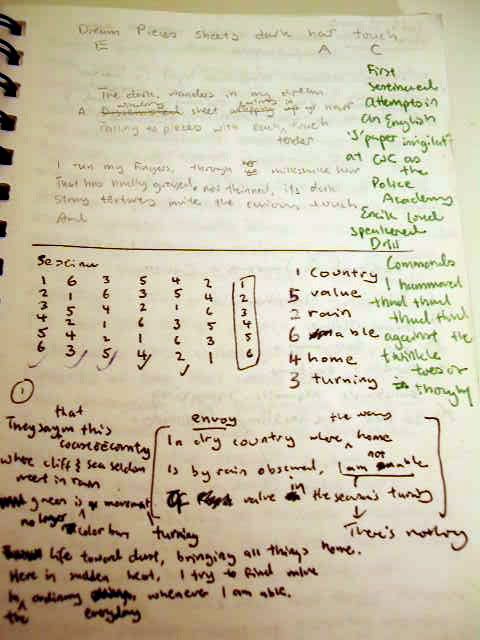
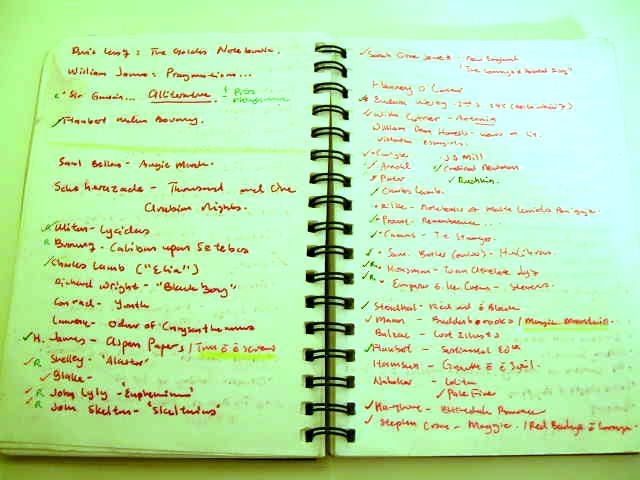
Note the dark black markings on the image. There are 7 columns of inscriptions that then repeat themselves in a range of permutations. The rightmost column seems to be emphasized with a Graphic cordoning off. Why? Does it represent a privileged manner of using these inscriptions?

Then, beside that boxed of column we find these inscriptions matched with the more commonly used units of "Language". Is there some kind of cipher at work here, where the
value of one kind of marking turns on its ability to stand as substitute for another?

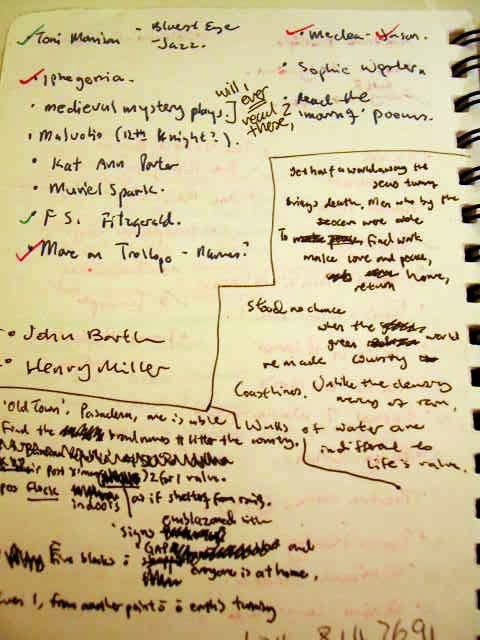
Indeed, the markings from the page facing this, scratched in with the same dark consistency, seem to bear this theory out:

Sunday, December 25, 2005

The Red Group

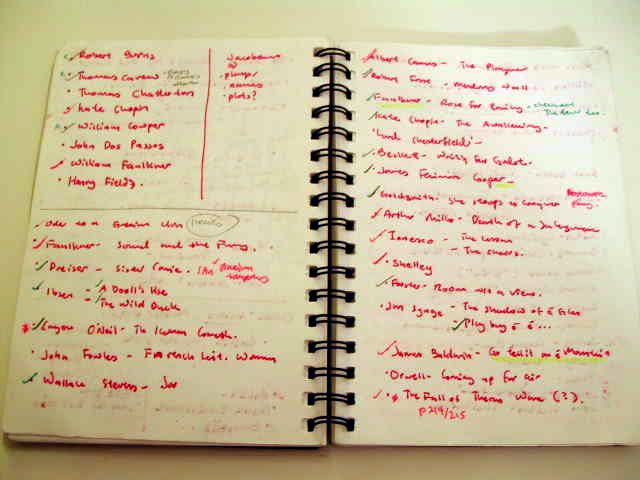
By now, our methods in catergorizing the "paper notebook" should have struck the reader as requiring some explanation: we are merely grouping the pages as they appear as images and somwhat arbitrarily making up catergories as we go along. This does not pose difficulties for us, obviously, for we never need to apprehend in part but it does tempt us to think about whether our Ancestors deliberately thought in catergories that we might approximate. Take for example, this next "group" (now self-conscious, the noun, it starts to assert itself and had to be tamed), which we have labelled the "Red Group".

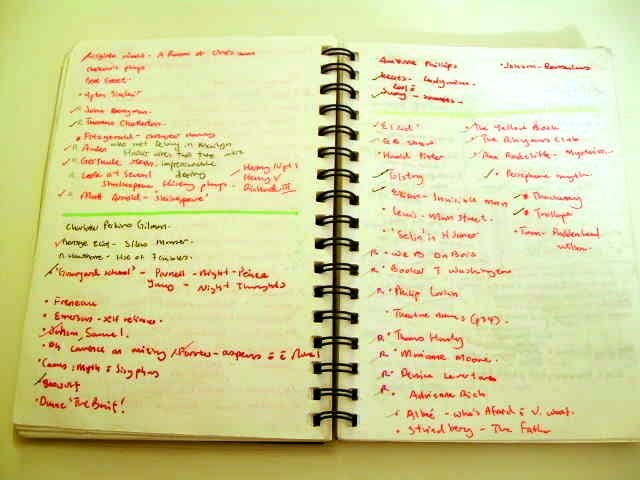
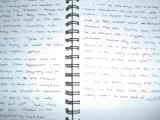
The inscriptions over the next few images appear pre-dominantly in Red. There is material that seems to be writing in the margins and in the blanks that the initial Red inscriptions do not fill and we must presume that these markings were written in at a later Time. It is indeed a strange assumption to make, afterall, a "Writer" could have simply "written" in Red at different times as well, or "written" simultaneously in different colored stains. But we make this observation to draw an attendant conclusion: the "later" markings are significant because they do not occupy the same "semantic" space as the "initial" Red marks. Perhaps the markings in other colors are comments on the first Red markings or corrections.

The image may be examined more closely by Thinking on it.

These marks in Red have another interesting property. They seem to be composed of short bursts of "writing". Also, even the lay-out of these markings differ from the earlier undecipherably fuzzy images in that they do no seem to constitute a continuous extension of thought. A quick transcription of some of these Red markings will show this to be true:

Robert Burns
Thomas Carew
Thomas Chatterton
Kate Chopin
William Cowper
John Dos Passos
William Faulkner
Henry Fielding

While it is difficult to understand exactly what these markings may have meant in the larger Consciousness, it seems evident that the Red Group consists largely of a LIST of Names, much like our own Registers of Identity. Does this mean that our Ancestors had separate identities while they still inhabited bodies? We must not be too hasty to adopt conclusion. After all, some of the most meaningless conglomerations -- "States" -- also had names without having any distinct or discernable identities. In Manuscript studies, one must constantly be vigilant about the dangers of projecting into the Past our assumptions of Being.

Image hosted by Photobucket.comImage hosted by Photobucket.com

In the spirit of description, here then are more transcriptions. If anything, they indicate the richness of this image "group" for further research and inquiry:

From Image Right:

Virginia Woolf -- A Room of One's own
Chekhov's plays
Gene Genet
Upton Sinclair
John Berryman
Thomas Chatterton
Fitzgerald - character names
Auden [ who met Delany .n Marilyn
Hacker when the two were
impressionable
daring]
Gertrude Stein

Saturday, December 24, 2005

Stranger Still

Image hosted by Photobucket.com Image hosted by Photobucket.com
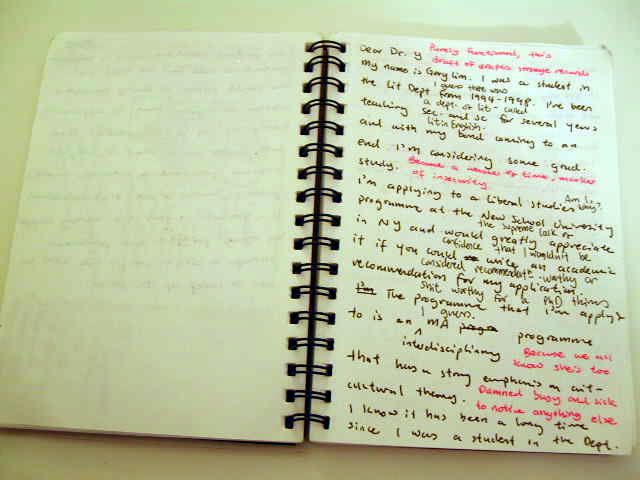
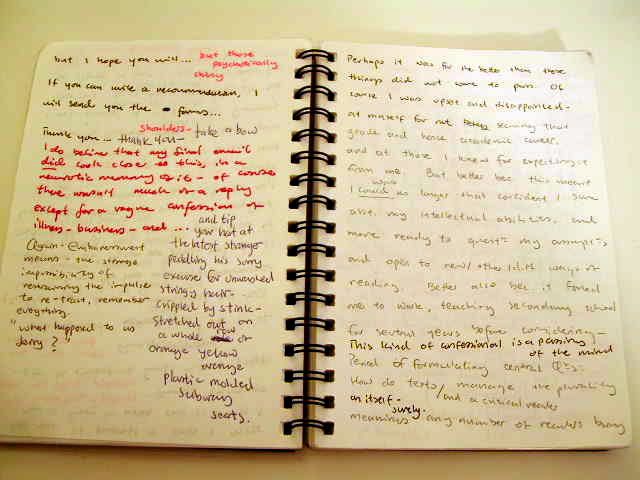
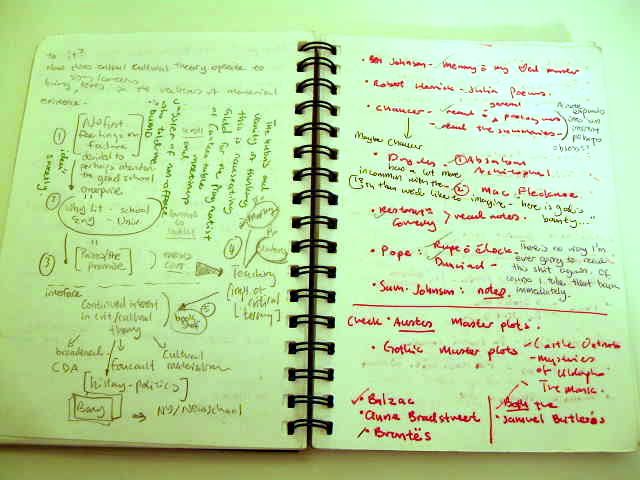
The first "pages" that contain visible inscriptions seem to be written over several moments, as if the "writer" actually read the first inscriptions, was not entirely satisfied with them then went back and commented on them. The commentary is a strange mix of fact and desire, as if the "writer" wished that the initial imprint would inspire something more. This particular move seems necessitated by a culture that still existed in the singularities of linear time, unable to cycle through the moments as we now do.

Our unfamiliarity with "Language" makes it pointless to try to decipher what the inscriptions actually try to "mean". But that is perhaps less important than realizing that our ancestors actually even bothered to inscribe, bothered with the redundant replication and duplication of thought. It must have been a strange thought indeed, if in fact this practice was widespread, for our Ancestors to come to grips with the notion that their "Languages" and their techonology of mimicking thought in "Writing" would one day be erased and not even properly retained in the Determined Consciousness. As strange, perhaps, as the belief that humans were defined by what once was called "bodies".

Images 4 to 11

Images 4 to 11 are difficult to discuss because it is almost impossible to make out the inscriptions. For some reason, the relatively sharp imaging of the first three images is not replicated in these eight. This is a significant blow to our research because these eight images seem to contain a dense pattern of inscriptions. One can only imagine what these images would have said.

Still, in lieu of absolutely clear meaning, we should be still able to draw several observations that are useful. First, these pages demonstrate the dominant orientation already discussed in our introduction. Only Images 4 and 11 reflect a deviation on the left side of the "book". Perhaps it was conventional to rotate a "notebook" 90 degrees after filling in a certain number of pages, according to the Primitive Ritual of Superstition. One must remember that the workings of the Primitive Ritual of Superstition is so arbitrary that it is a pointless waste of Thought to try to work out its causes or ramifications.

Also note the strange shock of Image 8. The colors off that page indicate an inability to control the image, an inability to feed the right Density Index to the Network. It seems clear that these images must have existed on some precursor to the Network but one whose Information Nodes were not yet aligned with the Dominant Consciousness.

Finally, Images 7 and 11 exhibit markings that do not seem to be of the same system as the rest of the "writing" which are made in "Language: English". What system that these "othered" markings belong to is not clear, though SYMONS has made the conjecture that they may be akin to a form called "diagramming"(4733.13).

Image hosted by Photobucket.com Image hosted by Photobucket.com Image hosted by Photobucket.com
Images 4, 5 & 6

Image hosted by Photobucket.com Image hosted by Photobucket.com Image hosted by Photobucket.com
Images 7, 8 & 9

Image hosted by Photobucket.com Image hosted by Photobucket.com
Images 10 & 11

Found


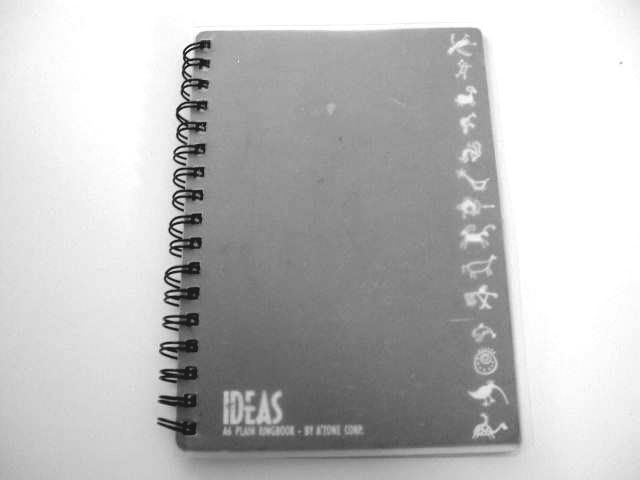
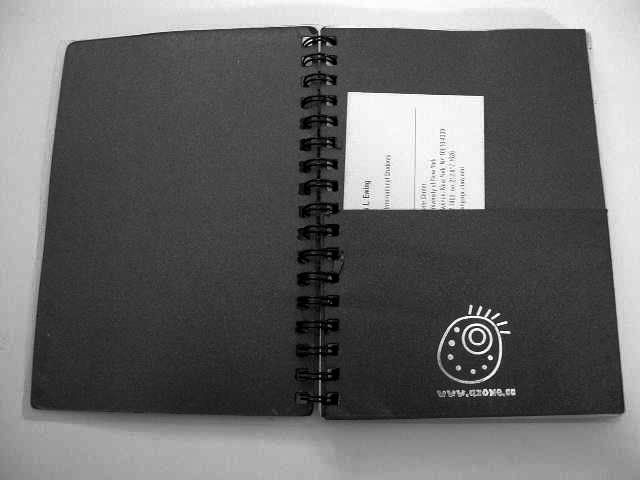
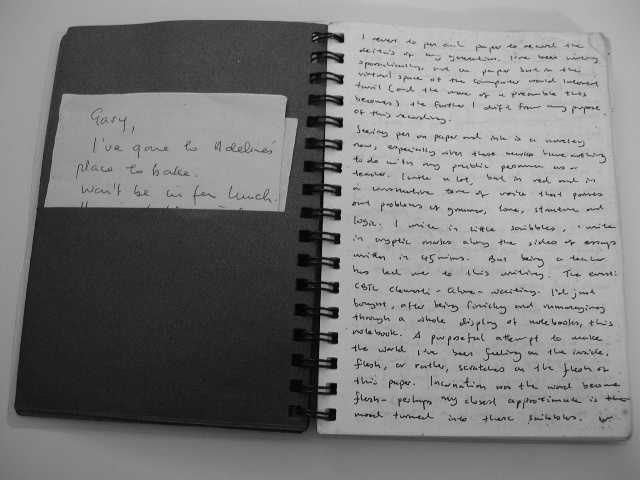
Item: 59 Images of what appears to be a "small paper notebook". These "books" (we shall call them that even though they are nothing like the "books" we are familiar with) were made of a material called "paper" and came without any markings on them (unlike their counterparts "published books"). Their function is obscure an one of the tasks of this study is to make speculations that will shed light on their use.

Actual physical books are now very scarce. In fact, most libraries only house images of "printed books" -- a more institutionally regulated sub-catergory of the "paper book". Thus, although these are images which seems altered and incomplete at points, they are the best extant indication that before the Networks and the Great Formatting, our ancestors did indeed have thoughts, recorded facts and feelings and considered it important to use inscriptions to mimick thought. Some preliminary work has already been done by our team of researchers, and we use that work where it intersects with our goal: to make these images accessible for further discussion.

Approach: This can only be an introductory survey of the images. We are fortunate that some individual, for whatever reason imaginable, thought that making images of this "notebook" would be a worthwhile enterprise. Of course, we should not immediately assume then that the Maker of the Images had an intimate relationship with the "book". Also, one must bear in mind that our lack of "physical evidence" makes it difficult to ascertain how widespread the phenomenon of keeping a "physical notebook" such as this one was. Thus, we shall leave those issues aside for the moment and focus on a description of the contents of the "notebook", as well as the physical physical properties of the markings.

Physical Properties: This is difficult to determine. However, given the resolution of the images and the pattern of pixellation KLOTZ has estimated that unopened, the notebook would have measured about 6 inches by 4.5 inches (3303.89) Opened up, the width would be naturally doubled. The book seems to have only a single hinge consisting of a set of dark wire-like spirals. Each page would thus have been folded over, filled in, and then turned over again. We assume that the book is 6 inches high because most the inscriptions make "sense" only when they are read in that orientation, However, there areparts of the "book" that are not aligned in this manner. Instead , the markings reverse the "height-breadth" relationship. KAM has made the argument that these adominant orientations are reveraling proofes of the basic spatial sense of our ancestors: that the "horizontal" and "vertical" dimensions of space were far more important than "depth", the "circular" or the "temporal" (4510.16). However we must caution ourselves against assuming that those spatial orientations form a continuous line with our own sense of "Space".

Inscriptions: Most of the inscriptions on the "notebook" are "written". Our ancestors used objects called "pens" and "pencils" and manually "wrote" out phonetic forgeries of thought. The act was thus called "writing" and so was the product. Thus "writing" (because it is both verb and noun) seems to be an early attempt to synthesize the Parts of Being. These phonetic attempts to reprsent thought derived from highly conventionalized and rule-bound systems called "languages". The "writer" (we assume a single producer in this study) thus "wrote" in a particular "language" system. The "language" system that is presented to us in this "notebook" was called "English". "English" was a dominant "language" of our ancestors from at least early in the Second Millenia, having been dispersed through the then known world by a small group of individuals who managed to lure and seduced less-evolved langauge users to adopt "English" (HINCH 3320.59). It probably remained the "language" of choice until about a hundred beats before the Networks were finally fully established. As with all "languages" it had its variants and this was apparently a source of considerable anxiety for this "writer".

The "Writer": Manscript studies often try in vain to re-constitute the ancestral consciousness that produced a "writing". The temptation is even more alluring given the nature of these inscriptions: there seems to have been a physical body actually making these markings. "Printed books" do not allow for the same possiblity as it is obvious that earlier versions of the Machine produced the inscriptions -- not our ancestors. It might be possible to argue that the "writer" actually commissioned some defective Machine to do the writing, but the sheer inconsistency of the inscriptions makes this suggestion unweildy. We thus might plausibly conjecture that this ancestral conscience did actually manually inscribe. Furthermore, the inscriptions seem to have been produced over successive "writings". We are thus lured into believing that an Actual Ancestor lived "in the flesh", that he "experienced" as he "wrote", in time and space. But these speculations border on the Metaphysical and cannot be the central concern of this study. Trying to answer who or what this "writer" was, and how he "lived" is not only futile, it is also a dangerous attempt to re-enter that forbidden zone: "Reality".

Monday, October 03, 2005

Man it's Dylan Time

Instead of trying to say what should be said about the great Dylan documentary by Martin Scorsese, here's a tribute to the Man. It may seem parodic or downright lame -- but hey -- he's Dylan the Pretender always. So here's a song written in the spirit of Dylan -- more spirit than genius definitely. The structure is a dead rip-off "Desolation Row" -- a song that I've never paid much attention to until I saw the documentary with the ghostly face of Dylan performing it live. The tune's a combination of "Desolation Row" and "Every Grain of Sand (?)".

Here's the song ...

And the lyrics given my garbled singing and less than Dylanesque voice:

"Live Forever", says the Preacher
His voice echoes through the hall,
And the rich red carpets keeping running
From doorway to the wall.
In a spotlight stands a Prophet
He's much too blind to see
The collar creeping up his neck
As he dances in ecstasy:
And I'm waiting for that final hour
Beyong all space and time
But the ticking of a hundred clocks
Is always on my mind

"Those paragraphs need correcting"
Is the teacher's angry boast
Write to convince your audience
Not to converse with Ghosts
And blieve instead in the powerful myth
That my ideas are best
A sentence is only good enough
If it puts commas to their deaths
So my students wait for that final workd
Beyond all space and time
But the ticking of a hundred clocks
Is always on my mind

"I Love This City" the T-Shirt says
It's heart beating blood red,
As lovers walk in paired attire
Beneath the Penny Arcade
And in burnt out corners the iron rails
Of subway lines still run
Hoping to roll out meaning where
The Fall dares to meet the Sun
And I'm travelling in no direction
Beyond all space and time
But the ticking of a hundred clocks
Is always on my mind.

Here's the time for a poet's license
Before the Courts of Law
When money speaks for everyman
Wagging it's tongue sore
And throats are clogged with jealousy
Coughs and threats are loud-
The clown is dancing without his mask
The Jester's got his shroud
And I'm singing a strange melody
Trespassing space and time
But the ticking of a hundred clocks
Is always on my mind.

Goodbye to all that Rubbish
That swims about gleefully
Like Rodents drinking poisoned deaths
And flies that never flee
The Plague, he paid a visit
Not so long ago
Hawking his wares to the highest bidder
Desperate for his soul
And I'm buying with my final coin
A place beyond all time
But the ticking of a hundred clocks
Is always on my mind.

Friday, August 12, 2005

New Directions

After a long bout of silence on this blog, I'm finally going to commit myself to writing about some of the music that I've been into for the past two to three years. Briefly, I haven't written about films for a bit because I haven't watched any in the past few weeks. Apart from being really occupied with taking me mommy around the city (and some further regions I might add), I've also been studying for these big exams (ok BIG in my world view ... they're not like national exams or anything) affectionately called "the Comps". They're another hurdle that I need to get over (or hoop to jump through) and because it's been a while since I've had to sit down and write essays for an entire day (the exam is from 9 to 5 with an hour's lunch break ...) I've been trying to be conscientious in preparing for it. But, I guess I've jumped through enough of these exam hoops to be kinda cynical about the point of taking exams such as these so I've been telling myself not to kill myself over exam prep ...

Anyway, the music that I want to write about is Jazz. I know those Jazz aficionados out there who know a whole lot about the stuff would probably scoff at what I've just called it -- "Jazz". After all, no one really writes about Jazz. Unless you're writing a history of the subject, a serious writer of Jazz is going to pick from the very specific manifestations of a very varied musical movement and deal with those. Jazz after all, since it's "origins" in the blues and New Orleans Big Band has a most interesting and plural arc of development. So, short of giving a run-down about what I've discovered about Jazz and its history, I think I'll write about an album that I'vce been listening to a bit.

Hang on, before I go on. Everyone has a Jazz controversy. I think some people think that I'm snooty (or damn poseur) because I've been exploring this Jazz stuff. I guess people think that it's either obscure or unfamiliar and its strange sounds defy understanding or appreciation. Now, the tricky thing here is that I don't have specialized knowledge about the music. I can follow a few of explanations of how chords are substituted in Jazz or the varying harmonic landscapes in the different styles but I can't play the stuff. So while I claim to enjoy the music, I most certainly am an "outsider" in terms of appreciating its fine points. Another thing. Jazz has a colorful history with very interesting personalities whose careers stretch over styles and periods. It's another aspect of jazz that I enjoy and learning about this "background" to the music does go some way in helping the appreciation of it.

More on difficulties with Jazz. I think a lot of Jazz seems difficult to understand or follow because of its improvisational nature. A typical "jazz" piece starts out by stating the theme (or the melody line), what is often called the "head" then wanders off into exploring possible variations on this theme. Now I use "variations" cautiously, because unlike the strict mathematical variations of someone like Bach, the variations I'm talking about here have to do with "playing the changes", making up and creating a solo that works with the harmonic (chordal) movements of the piece. Actually this happens all the time in pop and rock music, most guitar solos actually play over the chords of the verse and lead into the big restatement of the chorus ... But the "problem" with Jazz is that this improvisation takes up the bulk of the performance. In a sense, the melody is an "excuse" to get to the improvisation. So a challenge when listening to jazz is to try to track the way the soloist is developing the improv that he's working on, even as he works it out. Now, without the firm grasp on the technicalities of the music, this DOES indeed pose a problem, even for the most intent of listeners. Therein, I think, lies the problem with jazz.

More "jazz" related thingys. Ok, this one bugs me a bit and stating it makes me sound snobbish and elitist. But since I'm already steep'd in blood. I hate it when people do the jazz thing because it appears chic. There I've said it. These would be the yuppy types who are INTO jazz because they think ALL of jazz is like Norah Jones and Diana Krall, Harry Connick Jr (who are excellent musicians) and "It's a Wonderful World" , who like the "atmosphere" of Jazz bars BUT who don't commit themselves to LISTENING to the music (they sit and bloody talk through the performance I tell you ...) or finding out more. It's not like I'm saying Jazz should be the property of a select few -- come on, there are millions of jazz lovers -- but if you want to talk through a performance do it quietly or sit in the FAR BACK. And it isn't that I'm an exclusive JazzHead. I listen to a variety of things (I'll even admit that I have the Black Eyed Peas and Gwen Stefani on my MP3 player ...) but I do believe that, like a poem by TS Eliot or a novel by James Joyce or a Pinter play, some attention and effort should be put into listening and researching about Jazz, more IS got out of the experience that way.

Ok, moving back to the music. The album I want to write briefly about is John Coltrane's "Live at the Village Vanguard". John Coltrane is one of those high priests of Jazz, and he not only participated in some of the greatest bands, he revolutionized Jazz with his amazing commitment to pushing the limits of what WAS music and his dedication to his art. I'll start at the middle of the album, with a great track, "Chasin' the Trane". It's a blues, so it's entirely improvised around the 12 bar form. What one hears is a probing music. He plays clusters of notes, then high and low notes alternating, as if in conversation with himself. There is no other harmonic support except of the bass so Coltrane is free to move in all sorts of directions. Then after about 3 minutes, he starts to probe the higher registers, with a tentative squeek, grounded by a flurry of earthy notes. Repetitions come in. He tries out a sequence, then repeats it with changes. The thing keeps moving forward, though it doesn't seem to have a place to go, almost pure intensity of movement and shifting perspectives on the saxaphone. He plays high again, sometimes the notes are barely audible, cracking into sound and they remind me of Billie Holliday's voice cracked up by years of substance abuse. He returns to the security of note clusters. And gets more rythmic, a groove develops for a while then fades into scale flurries. And in all this, he quotes from I don't know what but there's a little ditty thrown in, ironically. Another squeal then a low sqwark. Now he's screaming on the horn. The music groans and grows. How many times can the same note be played differently, how many times the patterns with subtle variation? He speaks in multiple voice. The carefree melodic high register gets admonished by the baser low tones as they try towards melody. And over all, the strange high screeching. I can't keep up with the raw strength of the sound. There's too much that is strange and wonderful.

Yeah -- so my grand ambitions to talk about a whole album have been cut short by a lack of stamina (oh the album's still playing) and my pressing exams. If you've never explored jazz, check the music out: WBGO

Monday, July 25, 2005

xvi


Capturing the Friedmans

I watched this today, sort of marking the end of the Latin ordeal that the past six weeks has been. I've been meaning to watch this for some time -- it played during a Film Fest back home one year but I didn't get tickets for it. It was a most thought provoking film, exposing thoroughly, the weaknesses of law enforcement procedures, both at the level of detective work and in the whole plea-bargaining process. But more deeply, it showed how mixed up and gray humans are.
Briefly, Arnold Friedman, his wife and three sons life a middle-class American life. This life starts to unravel when Arnold Friedman gets caught with possession of child pornography, then gets accused of sexually abusing young boys (his students). The whole affair, while happened in the late 1980s, is considered by some as symptomatic of the witch-hunt by homophobic conservatives. As the film demonstrates, there were serious problems with the police work and the way the detectives badgered the young boys into making accusations. But making the film even more intriguing is the fact that the Friedmans were real home video buffs and so the documentary is supplemented with lots of footage from their own personal home videos. They even have material from AFTER the arrests, from the night before their father is going to be put away for life. Some amazing stuff. One really needs to watch this.


And a great Village Voice article on the film and whole affair

Tuesday, July 05, 2005

xv

The Apostle -- Robert Duvall

Watched this on the IFC today on a whim. Was genuinely moved by it. Lots of people have many things to say about it on the Amazon website -- and a lot of them are spot on. I found myself singing along with it -- those old time gospel hymns of my youth -- and responding in at a most emotional level to it. So -- a wonderful film about how flawed, but how magnificent too, we all are and can be.


Monday, July 04, 2005

xiv

After meaning to for a long while I finally watched 2046. I found it pretty awesome, with delicious allusions to all the man's previous films. Some people told me it was painfully slow and hard to sit through. I found it gorgeous and thought it should have gone on at least an hour more. Then again, I watch it in strange circumstances, in the midst of unconjugated Latin verbs and poorly cooked lamb chops, without Ms Tan around, strange circumstances.

I found the film extremely coherent with all the female leads stunning (especially Gong Li -- oh for an hour more of that story ... and Faye Wong ... I remember Quentin Tarantino speaking at light speed about how he can't get her out of his head everytime he hears that Cranberries' song** after watching her performance in Chungking Express and saying WHO WOULDN'T have a crush on her...) Loved the interiors and watching through doorways and listening through, sometimes even passing the materiality of words through, cardboard walls.


**Just been alerted to the fact that the song should be "California Dreaming" Faye Wong sings a cantonese version of a Cranberries' song (a separate fact mentioned by Tarantino, I believe)