Edna and I have been going to the movies quite a lot. Since the 23rd, we've gone to the cinemas and watched four films--Sherlock Holmes, An Education, It's Complicated, and Nine--which is pretty heavy movie watching traffic for us since we also watch stuff on DVD at home (which involved two Fred Astair films, The Name of the Rose, The Holiday - more Edna than me -, Purab Aur Pacham (me) and some episodes of The Gilmore Girls).
1. Sherlock Holmes: I really liked the gray gray landscape and the grandiose cinematography. The plot was terrible (when we got home I promptly insisted that we watch The Name of the Rose because it's so much better as a "mystery" movie even if that's the least of its concerns). Showing Holmes' mental processes in slow-mo before he acts was a nice touch but then re-playing everything (perfectly) in "real time" after encapsulated how predictable this movie is.
2. It's Complicated. We actually tried to watch this on Sunday but it was sold out. I can't imagine the hordes of teenage girls (yes, they were with their parents, but still ...) wanting to watch this. I didn't even really want to watch it. Still, when we returned on Monday, there was a sizeable crowd and lots of people were really enjoying themselves laughing at the romantic knots that old people tie themselves into. I suppose the fantasy about getting back with one's ex (especially around the Holiday season) after the kids have grown up is pretty powerful.
3. Nine. Because It's Complicated was sold out on Sunday, we watched Nine, which I really wanted to see anyway since I like Fellini films. I thought that the musical about the paralyzing, neurotic creative process (or elegant procrastination) was very nicely done. I have a thing for films where nothing much happens and Nine certainly fit the bill. I think the audience didn't really like it. A lady sitting to our right left during a Penelope Cruz number, never to return. Maybe watching voluptuous women touching themselves in time to music isn't something you're supposed to do on a Sunday in the South.
Still, I appreciated the whole meta-cinematic feel of Nine, especially how the "set" that gets taken down at the end without having actually been used to make a film IS the space where every musical number (save one) happens. It's just that kind of momentary recognition in a film that gestures to its status as a clever construct that I enjoy.
Having taught ill-prepared college freshmen this semester, I've been thinking a bit about how the A-levels were possibly the hardest and most stressful exams that I've ever had to do. Even though I took them with almost no pressure to do well (I was headed for NUS to do an Arts degree: four Cs would have sufficed; though, in accordance to the grim and deterministic laws of mugging, I ended up with much better grades), the sheer scope and intensity of the thing was quite staggering.
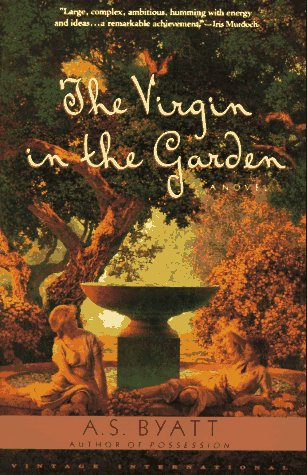
So it was with much interest that I watched An Education this week, where the A-level year of our protagonist, Jenny, played by a be-witching Carey Mulligan, takes an interesting turn as she becomes involved in a romantic tryst with a much older man. Like many a smart, independent minded female protagonist before her, she offers English as an A-level subject (with aspirations to read English at Oxford) and there are nice references to Jane Eyre in the film. A week before, as I struggled with final grading, A.S. Byatt's The Virgin in the Garden was a constant companion. That book also features a precocious 17-year-old on the cusp of an Oxbridge career. Frederica Potter, whose devastating intellect (and grating attempts to demonstrate it) is only matched by her adventurous cavorting with older men ends the book losing her virginity (as does Jenny) under the most unromantic of circumstances.
I'm wondering how the A-level year, when it isn't filled with anxious mugging, does represent a way into adulthood that "senior year" in an American High School doesn't. Are there American films and books that don't infantilize 12th graders and deal with girls on the cusp of becoming women at the same level of sophistication as An Education and The Virgin in the Garden? I've rehearsed a version of this argument on these pages (in a desperate attempt to rationalize my fascination with the High School Musical franchise) but the characters of Twilight series, Fast-times at Ridgemont High, Dazed and Confused, and the Gilmore Girls, and even Dead Poets' Society don't come close to capturing the aspiring sophistication of Jenny and Frederica.
Given that both works are set in the 50s and 60s, and that both Jenny and Frederica contemplate NOT going on to University--one to be married and the other with hopes of pursuing a career on the stage--I suppose the A-levels is much more the symbol of a final academic hurdle than senior year in High school will ever be. I'm sure there are interesting literary and filmic representations of precocious 12th graders but I think that given the cultural imaginary, "senior year" in High School can't ever take on the symbolic weight of the momentousness that is enshrined in taking the A-levels.
This being the start of the holiday season (not that it means we have less work to do), we watched "Love Actually" for the 521st time, after friends that we lent the DVD to returned it to us. ("It's just gotten back, why don't we watch it ....)
I've always had a vague notion about the racist constructions of desire in the film, but this watching crystallized my ideas. And since the film plays ad nauseam during the holiday seasons, here's to ruining everyone's favorite romantic comedy.
My analysis begins with Salvoj Žižek. Not an idea, but a Youtube video where he magically uncovers "The Sound of Music" as an unexpected space where Fascist fantasies live and thrive. Žižek's argument is simple. And while its extremely reductive, it's fun if you don't take it too seriously. (But how many of us DO take The Sound of Music and Love Actually much too seriously ...?) He argues that the Austrians, the Von Trapps included I assume, even though representing the anti-Fascist Austrian resistance, are figured along the lines of Fascist ideals: the children in uniform, marching, hierarchized according to age, all disciplined to sing and display their talent. (Of course for the sake for argument he conveniently omits the inconsistencies of this generalization.) On the other hand, the Fascist elements within the film are represented as sophisticated genteel, glove wearing, cigarette holder smoking figures, or as Žižek puts it, by displaced stereotypes of Jewish decadence. So, he says that The Sound of Music appeals because it is able to represent an official ideological construction that we have all been taught to embrace—anti-Fascism—while indulging our secret fantasies for Fascism.
So, Love Actually is about the impossible desire of the Other, simultaneously constructing a politically correct film depicting race as irrelevant to relationships but still nurturing racist attitudes unconsciously. Its constructions of black/brownness appear to embrace a post-racial cosmopolitan sexuality, where skin color is no boundary to love. But in its representations of inter-racial couples, especially of the black figures in the film, it indulges our secret racist fantasies while preserving the specter of miscegenation.
"No Surprises?"
The interracial marriage between Mark and Juliet (pictured above left) that opens the movie is the clearest example of this doubled construction of race. Even though Mark's best-friend, Peter (lurking in the background), is infatuated with Juliet, no love triagle ensues. Instead, Peter's repressed desire finally gets communicated to Juliet, first against his will when she watches the video he makes of the wedding, and later when he does his silent card messages. We're left to wonder about what might have happened between Juliet and Peter, and yet that possibility never becomes threatening because Juliet and Peter are both faithful and loyal as wife and friend to Mark. Yet it is precisely [a favorite word of Žižek's, often imprecisely used] because no love-triangle develops that we see how the racial construction proceeds. Even though Peter and Juliet never go beyond a kiss, their story arc is presented as the one that we should be interested in. Untainted by physicality, their (non)relationship becomes the distillation of what 'true love' is. Juliet shares intimate moments with Peter, realizing that he loves her when she watches the video, pretending that its "just carolers" so that he can 'speak' her of his desire. Desire can be kept covert but also be expressed because the mediation of art and technology makes Peter's desire, and Juliet's assent, non-threatening. Even so, the film's representation of these stolen moments constructs their relationship as the 'true' one. Mark, husband and black man, is cuckolded, even though 'nothing happens.'
"You'll Come Back a Broken Man"
Another story line: this time, the black man is marginalized and his status as desiring subject degraded. This story line features John and Judy, who are shy, reserved, but decent individuals even though they work as actor stand-ins in the explicit film industry. Their director, Tony, is black, and nameless until the end of the film.(1) He issues instructions for them to mimic physical intimacy, and he instructs them to perform smutty acts as he watches. He is the black man on the margins, the voyeur whose perverse pleasure is in watching, who can never become fully human in the way John and Judy do through the mundane conversations that develops between them despite their line of work.
Tony is also involved in the film's farcical plot, involving Colin Frisell's fantasies about American women. Believing that gorgeous babes will swoon over his cute British accent, he hatches a hare-brained scheme to go to some bar in America and work his charm. His Tony is the voice of reason, constantly telling Colin that he's totally out of his mind. Colin's crazy scheme actually works, and he beds a bevy of beauties on his first night in America. The black man, as movie director and Colin's friend, remains outside the orbit of desire. Even this farcical British swipe at America is constructed with a clear eye towards the racial taboos that police desire. Consider this: Is not a reversal of roles unimaginable? What if Colin the Brit were also Colin the black man, landing in Milwaukee and trying to pick up white women in a bar in Wisconsin with his cute British accent ... ?
"And they call it Puppy Love ..."
Finally, the possibility of the desires of the Other being taken seriously is undermined by the depiction of prepubescent love. Sam and Joanna's fledgling attraction for each other may be cute, but it's not to be taken seriously. Of course, there is the distinct barrier of geography with Joanna's return to America the very night that Sam expresses his interest in her, but this is merely a convenient 'out' for the film. In a movie where even the 'serious' adult relationships are somewhat suspicious fantasies about the possibilities of love bridging class and personality barriers, the novelty of the interracial union is made even more pronounced by this coupling. What is interesting is the fact that Joanna's black identity is withheld from the audience throughout the movie. Only at the end of the film do we learn that she is black, not only physically but culturally as she wows the crowd with her soulful Mariah Carey number even though Sam has agonized about her throughout. Her blackness, which appears momentarily, and then disappears on a jet-plane, is a key strategy by which the paradoxical racist–politically correct ideological fantasies of the film are sustained.
"All You Need is Love"
Does the film offer any possibilities of serious interracial relationships? One possibility is the romance between Jaime and Aurelia (above left). Even though Jaime is thoroughly English and Aurelia begins the film as a non-English speaking Portuguese immigrant working in France, they do end up together at the end of the film. Their attraction for each other, which blossoms despite their inability to speak to each other in the same language, seems to suggest an aspect of love that manages to transcend the barriers of culture and race.(2) Interestingly, Jaime's (and Aurelia's) sincerity is figured by their willingness to learn the other person's language, and the triumphal scene where Jaime proposes to Aurelia in ungrammatical Portuguese suggests that love can dismantle cultural and racial barriers. But, suspending for the moment the question of social class, is Aurelia all that other? She isn't caucasian, but she is not black either. Perhaps she represents a kind of limit, an acceptable difference that can be overcome through language classes on tape ....
By now, it should be obvious why I've put up the picture on the right, which is a snapshot of the movie's other triumphant relationship. Blackness is acceptable in positions of political achievement, but a romance between the Prime Minister and his tea-girl is much more acceptable as fantasy ....
In sum, I think it's possible to argue that while Love Actually promotes a politically correct view of interracial relationships, its success also depends on the way that it constructs an underlying racist fantasy that upholds the belief that 'true love' can only be found within the boundaries that govern Whiteness.
(1) - He only becomes "Tony" when one of the American babes Colin brings back, a cameo by Denise Richards, names him. He gains nominal identity only as part of the fantastical construct of American female desire.
(2) Another possible trans-racial coupling that I considered was the one between the characters played by Laura Linney and Brazilian superbod Rodrigo Santoro. But on consultation with the resident Love Actually expert (Edna), we agreed that the film doesn't really construct Karl as non-White.