Wednesday, June 21, 2006

Still ...

Despite beginning intensive French classes, I've managed to keep up with educating and occupying myself with more movies. It's a funny thing, these brief comments about film are really just a counter to remind myself what I've been viewing. It must also harken back to the advice that my English tutor in JC gave about film watching -- always write about whatever you watch -- that way your parents won't get on your case for 'wasting' your time at the movies. Of course, that was before DVD ...

Anyway -- the list, as far as I can remember:

1. More Felini: I went and looked up some of his earlier work. "La Strada" (The Road) is supposed to be the last film that Fellini did before breaking out of very conventional story telling. Apparently its succcess at the box-office allowed him more control and freedom over the kinds of experiments that he wanted to do in his films. It's shot in austere black and white with post WW2 Italy, its dusty country roads and scattered villages providing the backdrop of the film. It follows the fortunes of a travelling 'strongman' (ie he's a gypsy entertaining small village crowds to make ends meet) and his companion, a young girl who is 'sold' to him by her poor mother. It's tragic and pretty conventional though there's a tinge of sadness in every scene, even in the comic burlesque and Chaplin-like clowning that the young girl brings to the film. Another Fellini film: La Dolce Vita (The Sweet Life) is apparently the film that made popular the term "paparazzi". As this suggests, the film deals with the glamorous and decadent life of actors and celebraties and their numerous escapes into hedonistic abondonment. Most of the film tracks the late night activities of these individuals, all tied together by a writer, Marcello. Definitely highly stylized, with great control of light and dark spaces. It's almost a more coherent (and semiotically familiar) version of Fellini's later work, "Satyricon".

2. We just can't shake out the Merchant Ivory. Three films that deal with British / post-British India. "Heat and Dust", which was supposed to be the film that launched Greta Scacchi's career. White women falling in love with Indian men and screwing everything up. Pretty much in tune with the next film "A Passage to India", which paid more attention to inner struggles and the clash between cultures (though it isn't a Merchant-Ivory film but one by David Lean). Of course, I'm pretty biased about what a good film version of this book should look like cause I studied it pretty intensely for the A levels. It placed a lot of emphasis on the first portion of the book and really squeezes the working out of important implications to a rushed last half-hour. Still, this probably explains why I'd make a terrible script writer. Last on this part of the list, "Shakespeare Wallah", an old Merchant-Ivory production (60s?) that traces the fortunes of a company of Shakespearean actors that tour India after 1947, their dwindling audiences (over taken by Bollywood, of course) and a return, to England. Of course, the daughter (young English girl who has lived all her life in India) of the company's director, falls for a rich, young Indian ... Profoundly moving though, and some excellent snippet stagings of several Shakespeare plays (in a very 18th/19th C 'affected' manner).

3. I've also started watching the Black Adder comedies. The first series, which re-writes the history of pre-Tudor England has been the most enjoyable so far. The second series, which deals with Elizabethan England has its moments (and mad queen!) but there seems to have been an attempt to make adjustments to the series so that it caters for a different audience. The dialogue is just silly at points, instead of a clever and allusive re-working of historical (and dramatic via Shakespeare) givens.

4. And let's not forget the book. I also managed to sneak in "Arthur and George" by Julian Barnes. I fall into these moods where I realize that I haven't read any contemporary fiction in a while so I got this (a nice brand new hardback for seven bucks including postage ...) because I really like Julian Barnes. I must so it was very engaging and had some interesting tense shifts. But it definitely pales in comparison to "A History of the World in 10 1/2 Chapters" and "Metroland", because it tries to hard to depend on a mystery plot, when the materials at hand can't sustain a dramatic revelation. Anyway, that's probably a reaction to feeling a little let down by how it winds to a close. The earlier bits that track class and racial tensions in early 20th C England, were very nice. And the strange use of the SIMPLE present tense, and how that often shifted unnoticeably into a more conventional past tense of recounted events and reported speech, immensely disorientating and disturbing: it was as it the 'facts' were slipping out of one's hands, all the time.

Wednesday, June 14, 2006

The Shows Must Go On

In spite of the on-going World Cup matches, I've still managed to watch a few films. I just watch snippets of the matches, so perhaps it doesn' t really count but these American commentators are really irritating. They tend to give a lot of advice about what's going on on field (and on the poor quality of refeereeing) and always end up commenting on the chances of the US team (They're painfully optimistic -- "Italy is definitely beatable ..."). I guess it's the nature of football -- low-scoring and not a lot of goal mouth action -- that causes them to talk about it in this manner. Also, the terminology is sometimes irritating. There was a player down in the box and the commentator was screaming, "That's a Pee-Kay! Pee-Kay!" It took me a while to work out that he meant "penalty". They also try to keep track of all sorts of statistics like win-loss-draw records, percentage of time on the ball and number of 'assists' (a la American football and basketball) and by doing so, they're sometimes late about commenting on the action.

Anyway. In spite of all that -- some films:

1. Lady Jane. Before Mary and Elizabeth became queen, one of their cousins reigned shortly. for nine days, actually. Helena Bonham-Carter as a very young and precocious monarch. Quite an interesting one.

2. Bride and Prejudice. This is part of the Jane Austen track that was started earlier on. The songs and dance sequences are a strange (and often painful) blend of Bollywood and ... I don't know what ... but it was nice to see all sorts of accents coming into the film and clashing with each other. And of course, there's Aishwarya Rai.

3. Cambridge Spies. This was a BBC mini-series which is supposed to be more historically accurate than 'Another Country', which was just inspired by the "Cambridge Four". It doesn't just dwell on the time they spent at school but actually traces their careers as spies for the Soviet Union. Some super acting by Tom Hollander in this and it was very atmospheric and beautifully shot. I guess it captures the tricky and tortured motives of anyone whose trying to break out of a sterile and complacent society very nicely. Jumping off bridges at the University buck naked , that sort of thing.

4. Happy Together. This Wong Kar Wai I'll place as better than "Fallen Angels" but still not as good as "Chungking Express". The masochism of desire, heart wrenchingly portrayed.

Saturday, June 10, 2006

Fellini!


Federico Fellini's work is another theme that I've started in my film viewing. This takes the "genius director" thing in another direction, I guess, cause I think that becoming acquainted with directorial styles outside the Hollywood studio system is an interesting endeavor.

Anyway, I've started with the following. They weren't watched in close proximity -- I doubt this would be useful because they're all very lush films with so much going on!

1. 8 1/2 -- I've known about this film's reputation for several years but never got down to watching it. if I were forced to say something about it that encapsulates my current theoretical interests, I would definitely say that the film is a great text for demonstrating numerous aspects of psychoanalytic theory. Of course, this gets away from the film somewhat but ... It's about a director trying to make a film (!!) And the various social and sexual memories that the process condenses emerges through Fellini's distracted fragmented story-telling. It's highly entertaining with lots of humorous moments.

2. Satyricon -- This was a more stressful film to watch, not only because it was shot in a riot of color against drab stone settings, but because the episodic nature of the film really stretches one's ability to follow the arcs of desire (which is probably the point). The two main characters are Roman students who end up in a range of adventures (like fighting over a slave boy, becoming slaves on a boat and kidnapping a hermaphrodite demi-god ...) The body is on parade in all its splendor and wretchedness in this film. With so many bodies on display, in all shapes and sizes, it's hard to think of "surface" in the same way after this film.


3. Juliet of the Spirits -- A middle aged lady living in comfort gets her life disrupted by her husband's adultery and strange dream-like visions. The juxtaposing of the most ordinary indoor life of a housewife against the fantastically quirky moments where the repressed past haunts her, makes for interesting and disorientating film watching. As part of these three Fellini films, this would place in the middle of the other two in the way it disrupts linearity, with 8 1/2 being somewhat more conventional (though it gets away with that because the premise, a director struggling to make a movie, already alters one's expectations of a conventional story line) and Satyricon being the strangest of the lot. In an inversion of 8 1/2, here the female lead is confronted with her childhood.

More on Movies

1. Carl Dreyer. Danish director before and during WW2. I decided to check out his stuff as an extension of my Bergman obsession. "Day of Wrath" is a slow moving but emotionally sensitive chamber drama about a young wife falling in love with her step-son. A Bergman reference? Bergman seems to redo this theme, without the heavily religious overtones in "Smiles on a Summer's Night" where the whole affair ends up with a neat comic ending. The film of Dreyer's to watch is "The Passion of Joan of Arc". This was brilliant even if it is a silent movie. It has Antonin Artaud in the credits, though it's hard to work out which character he is (as none are really named in the film ...) though it may be that he is one of the priests that objects to the inquisition. The camera movement and ways that faces are framed are really original and almost obsessively twisted in a manner that forces you to wonder how he did the shot. I now know where Peter Brook got his opening seqence (largely remembered because I wrote an entire essay on these 30 secs of film ...) for his film version of "King Lear": an almost exact copy of Dreyer's opening!

2. Merchant-Ivory! Ah, being the good and faithful but always slightly troubled Anglophile that I am, I started a Merchant Ivory series. Watched "Howards End" (not so good) and "A Room with a View" (better). Esssentially -- how many times can Helena Bonham Carter and Emma Thompson appear in films playing approximately the same roles and get away with it. But truth be told, these films contain great dialogue and nuanced acting -- so -- no apologies!

3. Luc Besson's "The Messenger". So this also elaborates a "medievalism goes to the movies" theme. This was a badly made film. Dustin Hoffman as conscience / god / Satan in the last third of the film just sealed its fate. The strange Americanisms that enter into it are also very distracting. Booo!

Monday, June 05, 2006

Some Films

Yes, it's that time of year when I do nothing but watch all the videos I can get my hands on from the public library. So far, I've watched a few:

1. Another Country. This was pretty moving and beautifully shot. In it you'll see a very young Rupert Everett and an equally young Colin Firth (they were 25 and 24 at the time), playing 17 year olds. Yes, I'm a sucker for films about elite schools; it must represent some repressed desire to be colonized ....

2. The Prime of Miss Jean Brodie. Maggie Smith and another film about British public schools as breeding grounds for Fascism (and assorted responses to that ...)

3. Fallen Angels. I didn't like this as much as Chungking Express.

4. A Girl from Hunan. The blurb on the cover said that it was made in the wake of the Cultural Revolution and the photo of the director looked like it was from the Bureau of the Arts of Moving Picture Making. Slow-moving tale about the terrible consequences of child marriages (and thus squarely propagandistic).

5. Scenes from a Marriage. Exceedingly rewarding film watching (if emotionally exhausting). I watched the 5 hour "tv" version. It's quintessential Ingmar Bergman with two actors, one room and long long close-ups. Great acting from Liv Ullman and Erland Josephson. I spent the entire 5 hours trying to figure out how an actress can look so gorgeous one moment then absolutely dowdy the next. That and whether they bought the furniture for the sets from Ikea.

6. A Man for All Seasons. Otherwise known as "How Intellectuals Will Always Be Screwed By Bureaucrats". This was about Sir Thomas Moore and his refusal to have a stand on Henry the VIII's marriage to Anne Bolyn.

Now for the stuff that I'm only slightly embarrassed about watching:

1. Hero. Eh -- I like those kung-fu scenes in slow motion. I also thought that this release might have a little Quentin Tarantino 'talk-about-the-film' at the end because it was one of those brought to you by Quentin Tarantino things. Sadly, it did not.

2. Pride and Prejudice. Long BBC version with Colin Firth.

3. Pride and Prejudice. Short Hollywood version with Kiera Knightly (where EVERYONE looks good ...)

4. Love Actually. Yes and it ain't even near Christmas.

Wednesday, May 31, 2006

Thirteen Thoughts on Plagiarism

(with apologies, pleadingly offered, to Wallace Stevens)

I
In eight pages of writing,
The only original thing
Was the name of the student.

II
I was really disappointed:
Like the students
Will be when they get their grades.

III
Rushing to meet deadlines, students copy:
A small sacrifice when playing the academic game.

IV
An assignment and effort
Are one.
The assignment and effort and a student
Should be one.

V
I do not know which more to hate:
The desperation of silly excuses
Or intellectual deceit,
The student despairing
Or its result.

VI
Red filled the long margins
With frustrated scrawls.
The student's unacknowledged
Borrowings shadowed the page.
My mood,
Darkened by these shadows,
Tracked unsolvable riddles.

VII
O Gate-keeping White Men
Why do you insist on straight 'A's
Before allowing students the
Careers of a careered society,
Tempting them to cheat?

VIII
I respect decent attempts and
When I see them, I richly reward;
But I know, too,
That students get others
To write papers for them.

IX
When a student sniffles in my sight,
Then screams "Unfair!"
The irony is palpable.

X
What is it called when students
Try to turn in work previously turned in?
My attempts at generosity
Are confounded by stupidity.

XI
"I sent it over the internet!
Last Saturday - you haven't received it?"
Once, e-mail actually worked.
Now, magic filters surely do
Detect and erase assignments
Sent by students!

XII
The semester has ended.
Some students must have failed.

XIII
With citations, it's called "Research".
With poetry it's called "Parody".
And it's all entirely inconsequential
For the student who
Just wants that damn degree.

Sunday, May 21, 2006

Spicing the Grail

Here's a project that I've been working on. It's supposed to be the beginnings of a hypertext edition of a poem. The poem is by Jack Spicer. Jack Spicer was a real person. Jack Spicer was a poet. He wrote many influential poems. He was associated with the San Francisco Renaissance. He believed that poetry is dictated. He took dictation from Martians.

The poem is called "The Holy Grail". Spicer wrote it from 1961 to 1962. It was published in 1964. First editions are rare. There is a "pirate" edition in the Columbia Rare Manuscript Library. How does a "pirated" edition find its way into the Rare Book collection of a venerable academic institution? The word "venerable" reminds me of The Name of the Rose. It reminds me of "Venerable Jorge". Another pirated edition, another work.

I am only slightly embarrassed that my interest in this coincides with Tom Hanks and bad hair. But there are many grails. It is a poem in seven "books". Each book has seven parts. Spicer called this a "serial" poem.

The point of this edition are the annotations. There are many references in the poem to Arthurian legend. I tried to track down these references. I annotate non-traditionally. I used a code that enables "one-to-many" links. It is quite novel. Suat, a frequent tagger on right, helped with making the code work properly. Many thanks, Suat.

At this point, only the first two "books" are annotated. There is much to be done. But you can read through the whole poem if you like. The best browser to use to view these pages is Firefox. They work fine with Netscape as well. You will run into problems if you use Internet Explorer.

Spicing the Grail

Wednesday, May 10, 2006

Man Gave Names to All the Animals

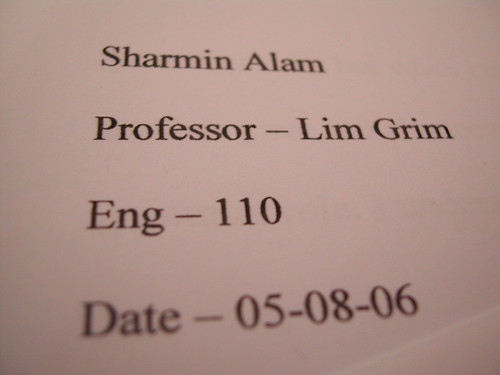
As the school term winds down here and a flurry of final papers that need to be graded descends upon me, I've noticed that the most creative bit of writing that I'll ever see from my students doesn't really occur in the essay proper. Instead, it's tucked away, in the top left-hand corner of every paper, right after the heading "Instructor: ..."

I've been named a good many things in these past two years. The obvious mispellings still occur even after I've been with a class for the entire semester. The most common are the relatively basic additions or changes that remind the teacher that he's got his own name spelt wrongly and that there is a better way to spell it. To these students, I'm either "Gari Lim" or "Garry Lim", depending on their dislike for "y"s or penchant for "r"s. Then, there are the students who refuse to believe that my name is indeed a two-syllable word and insist on transforming it into a comment on my personality or outlook on life. To them, I'm "Gray Lim". Others decide that I'm really quite a jolly chap. Either that or they insist taking our class discussions about sexual identity one step further by calling my declared heterosexuality into question and labelling me "Gay Lim". Just last week, one student insisted that "Gary" was much too common for her tastes and opted for a version that put me right in the middle of the 18th century, parasols and a Jane Austen novel: "Garrick Lim".

My last name has come under assault as well. Some students, probably after a nasty case of food poisoning in Chinatown or an unpleasant run-in with Canal street touts, rather not have a Chinese teacher teach them English. To them, I'm Korean and "Gary Kim". The most subtle substitution so far has been a powerful indictment of the meaningless and arbitrary conventions with which we phoneticize Mandarin names with the latin alphabet: "Gary Lym".

And today, I received a paper that just took the cake. I haven't really worked out what this student was thinking, but hey, I'm open to suggestions:


Monday, May 08, 2006

On Power

If power lacke on any syde on that syde is no power, but no power is wretchydnesse. For al be it so the power of emperours or kynges or els of their realmes (whiche is the power of the prince) stretchen wyde and brode, yet besydes is ther mokel folke of whiche he hath no commaundement ne lordshyppe; and there as lacketh his power his nonpower entreth, whereunder springeth that maketh hem wretches. No power is wretchydnesse and nothing els. But in this maner hath kynges more porcion of wretchydnesse than of power. Trewly, suche powers ben unmighty, for ever they ben in drede howe thilke power from lesyng may be keped of sorow; so drede sorily prickes ever in their hertes: litel is the power whiche careth and ferdeth it selfe to mayntayne. Unmighty is that wretchydnesse whiche is entred by the ferdful wenynge of the wretche himselfe, and knot ymaked by wretchydnesse is betwene wretches; and wretches al thyng bewaylen. Wherfore the knot shulde be bewayled, and there is no suche parfyte blysse that we supposed at the gynnyng. Ergo, power in nothyng shulde cause suche knottes. Wretchydnesse is a kyndely propertie in suche power as by way of drede whiche they mowe not eschewe ne by no way lyve in sykernesse. For thou woste wel," quod she, "he is nought mighty that wolde done that he may not done ne perfourme."

-- Thomas Usk, The Testament of Love Book 2 Chapter VII

Promptly ...

Promptly at nine, start the section

He tried to steal my pen
Lehman? My High school
Was up in the Bronx
"Walton High?"

Thick stubby nails chewed through
I went to Bronx Science
"Bronx Science?!"
Yeah ... Bronx Science

With woolly beard overflowing face
There's a story about that
I was good at
Math still am

"NYC. 2005 Samuel R. Delany"
Took the special exams
And got in -- Math
I'm good at not Science

"And the name's ... Gary?"
After four years
I was still a
Sophomore

"And Carnivals ... I'll read some"
Wasn't structured enough
Skipped out too
Many classes

"Is Atlantis ... that and Of Plagues ..."
So I dropped out took
The GED
And had a baby

"My only experimental work ..."
I'm going to major in
Accounting -- I'm
Good at Math